


What crop would you grow on Mars and how would you do it? Part 2
- Sep 16, 2017
- 8 min read
Fields and fertilizers

Just how much space do we need to grow lentils? Focusing on the first 10 years of the mission, there would be a total of 20 astronauts on the red planet by the end of 10 years. An optimal target on earth for lentil growth is approximately 400,00014 plants per acre, with around 20 plants per square foot14. The energy intake of an average human is approximately 8700 kJ per day. In order to estimate how much energy each astronaut would require daily, I am assuming all the astronauts (male or female) have an average weight of 77kg and a height of 6’0 ft. (taken from male and female global averages). Using a calorie calculator, the astronauts would require approximately 11,700 kJ 15 16per day. Since 100g of lentils provide 1,477 kJ4 of energy, each astronaut needs to consume 792g of lentils every day to sustain body and muscle mass. 10 years amounts to 3652 days (including 2 leap years). To calculate the minimum mass of lentils required over a 10-year period to feed 20 astronauts: 3652 days x 792 grams x 20 astronauts ≈ 58,000 kg of lentils. Normal lentil plants have around 150 pods13, with 1-2 seeds per pod, totaling to approximately 225 lentils per plant. As there are 220,000 seeds per kilogram14, the total number of lentils ≈ 1.276 x 10¹⁰. Dividing this figure by 225 yields a rough result ≈ 5.67 x10⁷ plants over a 10- year period, or 5,670,000 plants per year. Since the greenhouse can grow 2 cycles of plants per year14, the greenhouse can accommodate up to 2,835,000 plants per cycle. Given the approximate plant density of 20 per square foot, the greenhouse must be around 141,750 square feet, equating to 13170m2 (115m x115m) in total leguminosarum will not be present on root nodules of Martian lentils, the main fertilizer to be used is Di-ammonium phosphate at 55kg per hectare13, or 1450kg for 10 years, which provides sufficient phosphorous and nitrogen for the plant. Lentils require 200lbs per acre13, or 5900kg for 10 years. The final crucial mineral required is Sulfur. Elemental sulfur should be avoided since it reduces soil pH. Since Martian soils already have small quantities of sulfur present, no more than 15 pounds per acre13 should be used (975kg for 10 years), as excess sulfur concentration decreases lentil yields.
Martian Settlement
One final issue to address, before moving on to how the lentils should be grown, is the settlement for the astronauts and “greenhouse” for the lentils. I will assume that the organization and actual transportation of the settlement from earth to mars will have been previously dealt with already. According to Mars One’s website, each astronaut will have approximately 250m2 of living space on mars. Since there are 5 astronauts per trip compared to Mars One’s 4, the total habitable area of the settlement will be 1250m. The settlement must be buried at least 1-2 meters under Martian soil, to protect the astronauts from the lethal doses of radiation. Radiation on mars comes from two sources: the sun and intergalactic cosmic rays. Both sources of radiation are made from protons to heavier elements, fired at 3 x 10⁸ ms-1.

Polyethylene is a substance that can potentially mitigate majority of the radiation from cosmic rays, since polyethylene is extremely rich in hydrogen. Since hydrogen atoms consist of a single proton and an electron, the H atoms in polyethylene can block the protons from cosmic rays extremely well due to the tiny size of the H atom. The settlement could be coated with a layer of polyethylene, which would greatly reduce the radiation doses the astronauts would receive. The schematic in Figure 4 shows the greenhouse is separated into 5 smaller greenhouses. This prevents all the crops being killed in the event of a disaster. Each greenhouse will have polycarbonate walls (groups of thermoplastic polymers with carbonate groups), with steel frames as the skeleton. Polycarbonates are extremely strong and can be easily molded into shape. All the greenhouses should be coated with a layer of clear polyethylene to protect the crops from radiation. Since mars experiences frequent dust storms, all the greenhouses must be sealed properly to prevent entry of unwanted dust. Electrical pumps could be installed in each greenhouse to regularly pump in CO2 from the Martian atmosphere into the greenhouse. Rows of fluorescent lamps12 should be installed on the roofs of every greenhouse to provide artificial light to growing crops if sunlight is temporarily unavailable (during a sandstorm). Power for these lamps and the settlement will be provided with numerous solar panels, scattered around the settlement. Since sunlight can be concentrated onto the solar panels (addressed page 5), solar panels are the most efficient method of gathering energy. Multiple solar batteries20 can be implemented to store the energy generated from solar panels, which would be readily available for use even during the night.
Oxygen Production
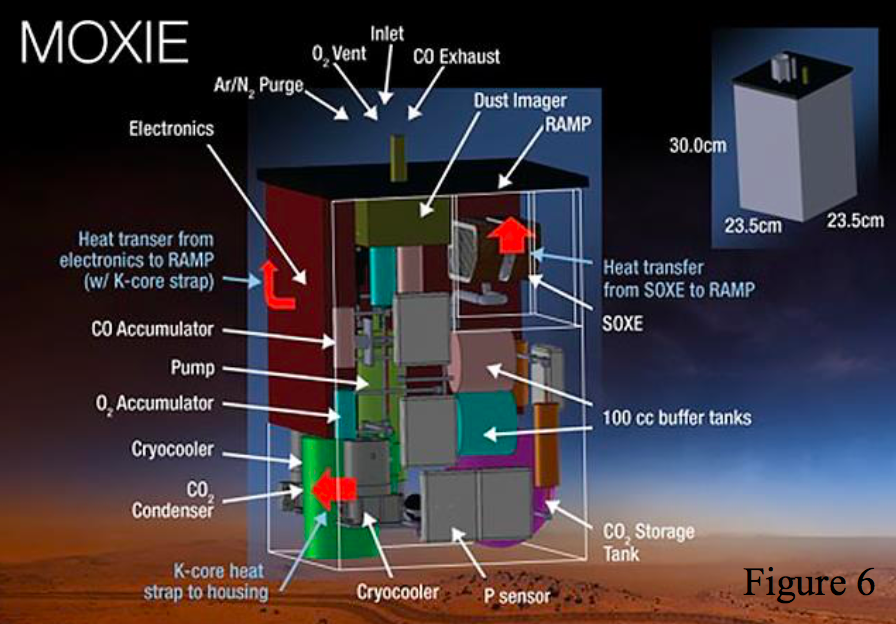
Since both the crops and astronauts require oxygen for aerobic respiration, the lack of oxygen in mars’ atmosphere is a large problem21. However, due to having access to sufficient electricity and an almost infinite amount of liquid water (addressed page 6), electrolysis of water is potentially a viable option to retrieve breathable O2.(2H2O → 2 H2 + O2). Another method of oxygen generation is known as MOXIE 19(Mars Oxygen ISRU Experiment); a prototype oxygen generator designed by NASA (Fig5). It utilizes zirconia electrolyte cells with thin electrodes coated with catalytic cathode and anodes. CO2 flowing over the cathode under electrical current causes it to be electrolyzed. Oxygen ions produced are driven though a solid oxide electrolysis stack and is oxidized, to produce an O atom. These atoms then combine and produce gaseous O2. Combining this technology with electrolysis of water should provide sufficient oxygen to all the astronauts and plants to grow healthily.
Terraforming Mars
Martian atmosphere causes a range of problems. The first problem is dealing with the wide range of surface temperatures, ranging from -125 Celsius. at the poles in the winter to 20 °C at the equator in the summer. Freezing cold temperatures would inhibit seed germination completely and thus spoil the mission. Secondly, mars has an extremely thin atmosphere, at 600 pascals compared to earth’s 101.310 kilopascals at sea level or equivalent. This means that liquid water cannot exist on the surface. One potential solution to tackling both these problems, is to utilize either orbital reflectors or stationary reflectors23. Orbital mirrors orbit around mars, reflecting the sunlight from the sun onto the poles of mars. Similarly, stationary mirrors are stationed on a celestial body, such as Phobos, Deimos or our own moon. Mars has 2 polar ice caps, one at the north and the other at the south. The northern ice cap is 1000km wide whilst the south is 350km wide. Both ice caps consist of frozen water as well as dry ice (frozen CO2). The Mars Reconnaissance Orbiter has found a large deposit in the southern ice cap that contains the same volume of frozen CO2 compared with current atmospheric CO223. Scientists

estimate the volume of dry ice deposit at the south pole is around 10,000 km3, which is approximately 80% of the current CO2 in the Martian atmosphere. Ideally, constructing a gigantic adjustable reflector on the surface of our moon is a more viable and economical method compared to orbital reflectors. The reflector must be in concave shaped, like a satellite dish, which helps concentrate the amount of sunlight onto the poles. The reflector would have to be at least 100km wide to reflect enough sunlight to cause sublimation of CO2 and melting of water, given that approximately 5K increase in temperature is sufficient to cause CO2 sublimation. Aluminum mylar is one of the most reflective materials in the world and hence is the ideal candidate to be used as the reflective surface. Since the mass of such reflector would be astronomical, it would therefore be logical to transport materials in portions to and from the moon (perhaps via a space elevator in the future). There are, however, limitations to this method. Our moon is constantly orbiting earth, which means there are times where the reflector is unable to reflect light onto the polar caps. Since mars undergoes orbital variations which affects the amount of sunlight it receives, the reflector must be constantly reflecting sunlight on mars especially during the winter season to counteract the effects of colder temperatures causing re-freezing of CO2.

Assuming all the CO2 in the southern cap area sublimates (10,000 km3), atmospheric pressure would double, from 0.6kPa to around 1.2kPa. Interestingly, water has a triple point25 (the temperature and pressure at which the 3 phases of a substance gas, liquid, solid can coexist in thermodynamic equilibrium) of 0.611kPa, which is 0.011kPa above the average Martian atmospheric pressure. Doubling the atmospheric pressure allows liquid water to run on mars without problems. Along with the CO2 released from the poles, water vapor would also be released into the atmosphere. Combined with the CO2, this enhances mars’ greenhouse effect. Mars absorbs the short wave solar radiation and reflects long wave radiation in return. The long wave radiation is trapped by the thickened atmosphere and reflected towards the mars, causing internal heating and global warming. This greenhouse effect would cause sufficient heating of mars’ surface that living nearer the poles would be possible. With a thicker atmosphere combined with sunlight from the reflector, average temperatures along the equator of mars could would easily surpass 0 °C during the summer, possibly reaching up to averages of 10°C. Given that the south pole contains 1.6 x10⁷ km3 of water, the approximate location of the settlement should be just somewhere below the equator, potentially the Huygens crater26.
Settlement location
The Huygens crater is located 304.4°W, 14.0°S26. Scientists have found evidence of channels along the crater, which conveniently allows liquid water to flow from the south pole to the crater. In addition, the crater is rich mafic minerals such as pyroxenes, which are silicon aluminum oxides with elements such as Calcium, Zinc, Manganese,andIron27. Thisunique soil composition, in addition to its position near the equator, make the Huygens crater an ideal candidate for the construction of the mars settlement.
Challenges
Unfortunately, there are some problems that cannot be fully solved, even with current technology, which will heavily affect the health of the crops. Mars has a mass of 6.4 x 10²³ kg, which is 10% the mass of our planet. Since the gravitational strength on mars 62% weaker than earth’s, this will disrupt plant growth through a weakened positive geotropism effect11. Weak gravitational strength affects how the amyloplasts in the statocytes of root caps sediment in response to gravity. Plants have been grown in space as part of an experiment. Results showed that in a microgravity environment, growth directions were completely unregulated, since auxin distribution in shoots are not even. However, whilst mars has a week gravitational field, it is far from being a microgravity environment, thus the effects of weak gravity on growing crops should not be too significant.
Mars experiences regular dust storms, large annual dust storms and massive dust storms. Massive dust storms, which occur once every 3-4 years, kick up enough dust to cover areas the size of continents for weeks on end.
During such events, the crops will receive no natural sunlight, which can lead to relatively stunted growth.
The final problem is the abundance of perchlorate chemicals in Martian soils. Perchlorates are salts (ClO4-) which are readily soluble and the salts dissociate into the perchlorate anion. Perchlorates have been linked to numerous health hazards, especially it’s negative effects on the thyroid gland, as it acts a competitive inhibitor of the sodium-iodide symporter protein. Perchlorates compose up to 0.5% of Martian soils; which is a significant enough concentration to cause potential problems in humans. There are possible soil treatment methods of perchlorates, such as utilizing ion exchange technologies (reverse osmosis). These methods are not 100% effective and cannot remove all the perchlorate ions from soil, but they do manage to reduce the concentrations to a level where consumption will not be fatal.
Conclusion Technology is progressing at an unimaginable rate, with the limits of human knowledge being the only boundary to success. With massive budgets and an increasing number of wealthy individuals turning their attention to the idea of colonizing mars, it really is a matter of time until the first astronaut steps out of the spacecraft full of lentil seeds, onto the red planet, leaving a large footprint in the dust - a small symbol of mankind’s astronomical technological progress in the 21st century.
Comments